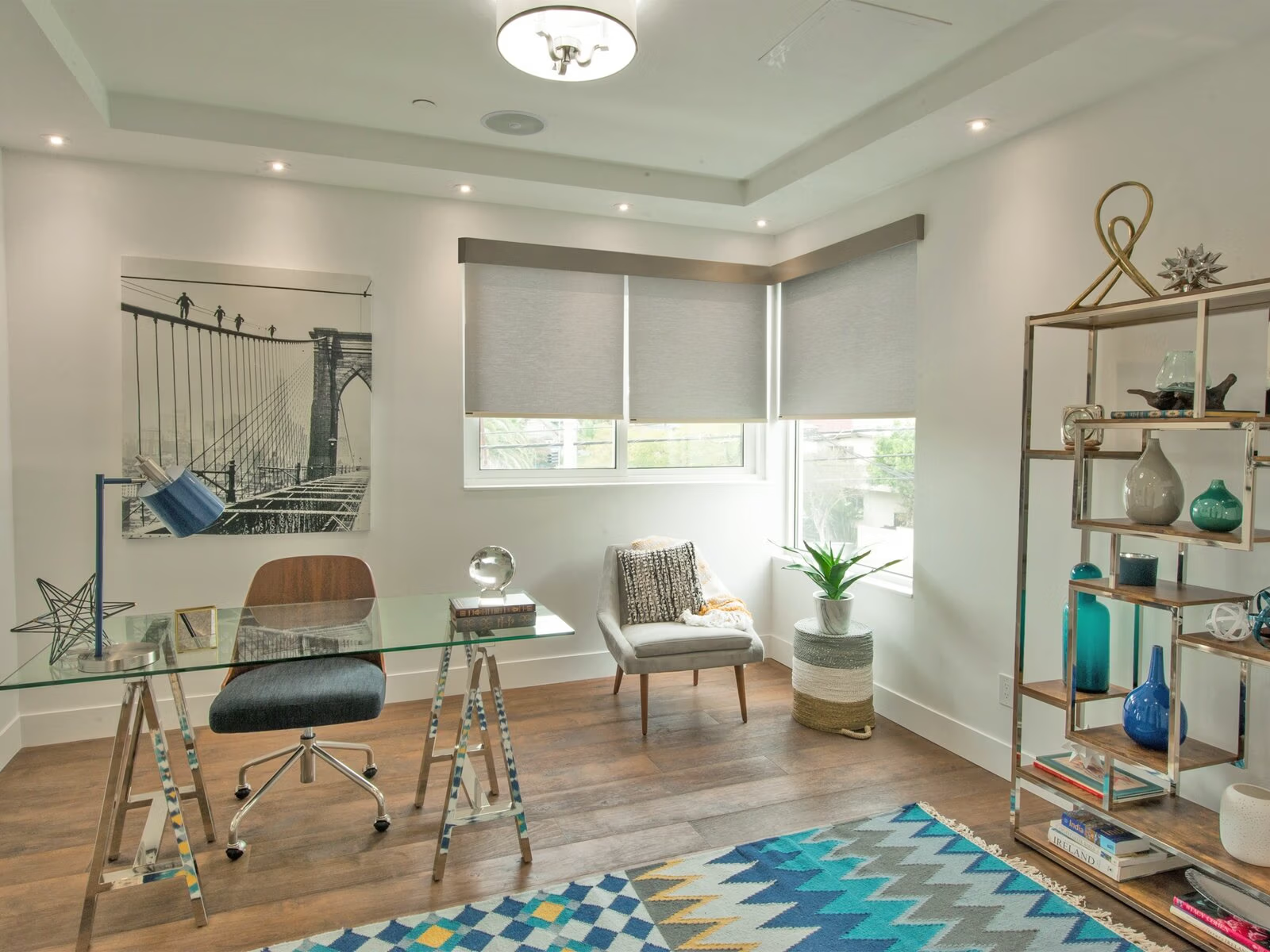
The home office stopped being a temporary arrangement years ago. It’s now a permanent room in millions of homes, a spare bedroom converted, an attic finished, a corner of the dining room claimed for good, and of all the decisions people make about that room, the desk, the chair, the lighting, the monitor, the windows are almost always the last thing considered and the first thing that causes daily frustration.
It’s a specific kind of frustration, too. The glare is washing out your screen by mid-morning. A window directly behind you, turning your face into a silhouette on every video call. A west-facing room that’s unworkable from two o’clock on. The afternoon sun heats a converted attic office to an unusable temperature in July. None of these is solved by the treatment that came with the room.
The home office asks something different from its windows than any other room in the house. It needs light; natural light genuinely improves focus and mood, but it needs that light controlled, precisely and often automatically, across a full working day. After years of designing home offices across the tri-state, here is how we think about getting the windows right.
Start With the Screen: Glare Is the Core Problem
In a bedroom, you start with sleep. In a kitchen, you start with moisture. In a home office, you start with the screen.
Where does the light fall on your monitor, and at what times of day?
This is the question that determines everything. A north-facing office has soft, consistent light and very little glare, a lucky position that asks little of its treatments. A south or west-facing office is a different story: direct sun tracks across the room through the working day, throwing glare onto screens, washing out displays, and making the space progressively harder to work in as the afternoon wears on.
The treatments that solve the home office consistently are solar shades, roller shades, cellular shades, and drapery, often in combination. But the starting point, more than in any other room, is glare control. Get that right, and the rest follows.
Solar Shades: The Home Office Workhorse
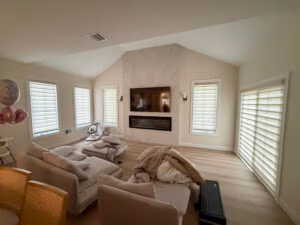
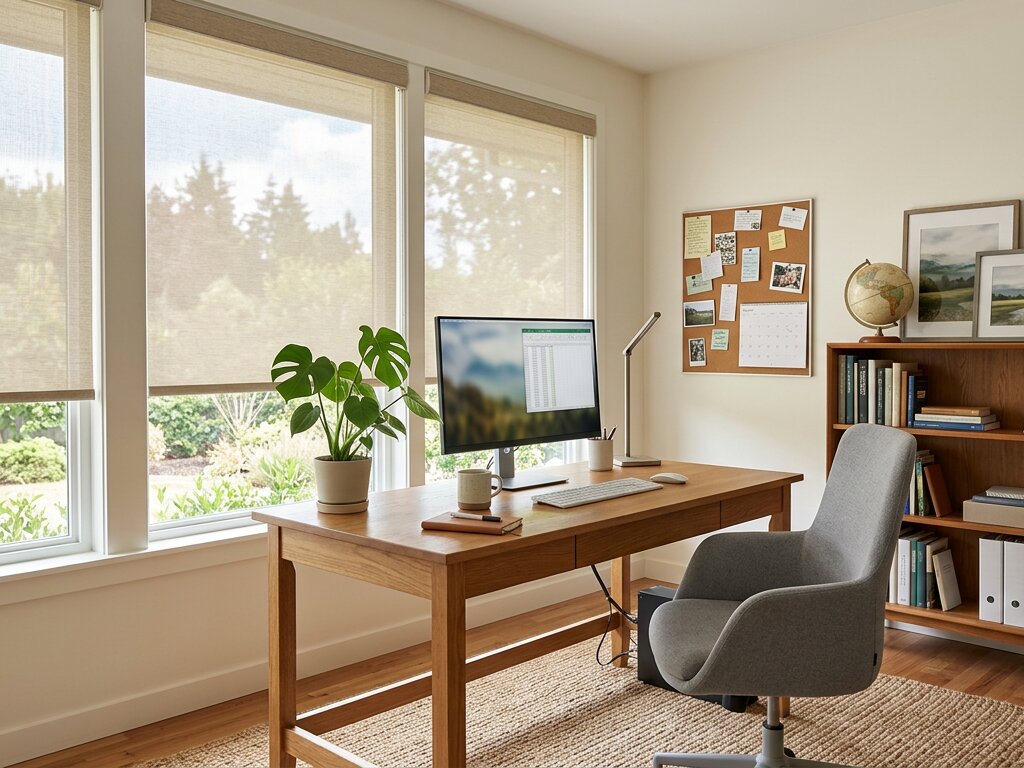
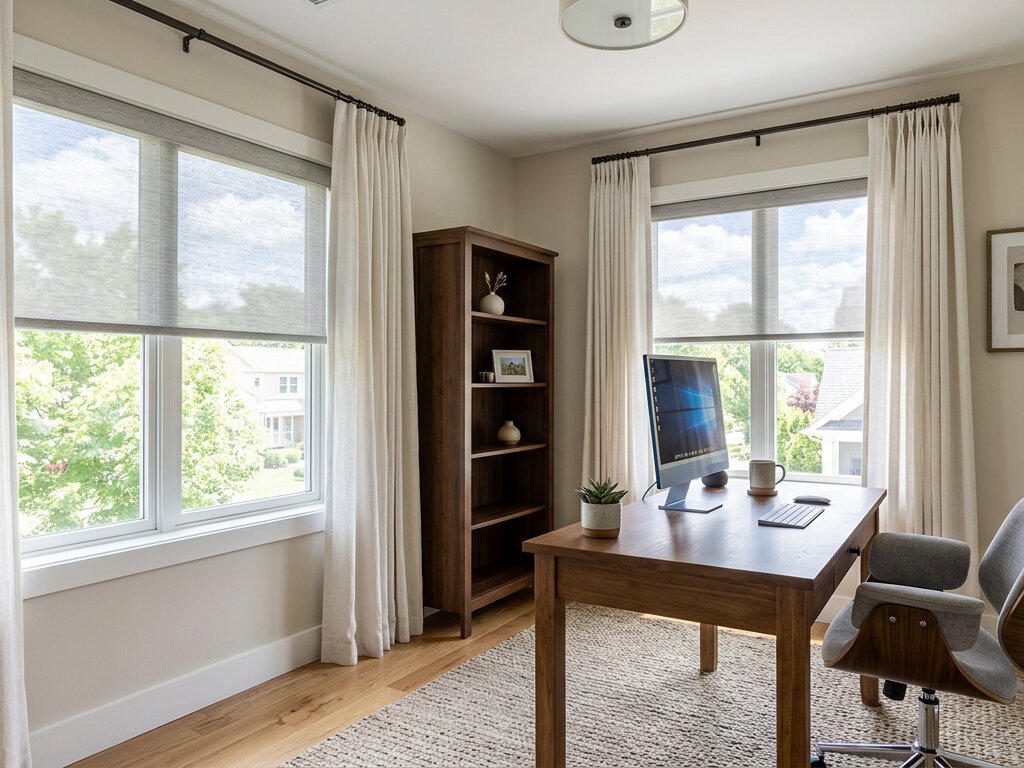
If there’s one treatment built for the home office, it’s the solar shade. Its screen-weave fabric is engineered to do exactly what an office needs: cut glare and block UV while preserving the view out and keeping natural light in the room.
That last part matters. The instinct with a glare problem is to block the window entirely, but working in a cave is its own kind of misery, and you lose the daylight that makes the room pleasant to begin with. A solar shade lets you keep the light and the view while taming the harshness, which is precisely the balance an office wants.
Solar shades are specified by the openness factor, which describes how much light passes through the weave. For a home office, the choice depends on the exposure:
A 5% openness shade gives strong glare control and good daytime privacy while keeping a usable view, the right call for most south and west-facing offices. A 10% openness keeps the view clearer and the room brighter, better suited to offices with milder light or where the view matters more than maximum glare control. For a hard western exposure with serious afternoon glare, a 3% openness pulls the light down further still.
The result is a screen you can actually see, a room that stays bright and connected to the outdoors, and protection for the furniture, rugs, and equipment that direct sun otherwise fades over time.
Roller Shades: When You Need to Go Darker
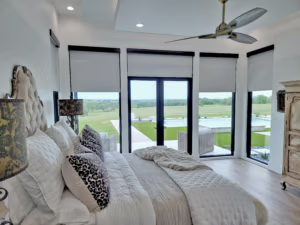
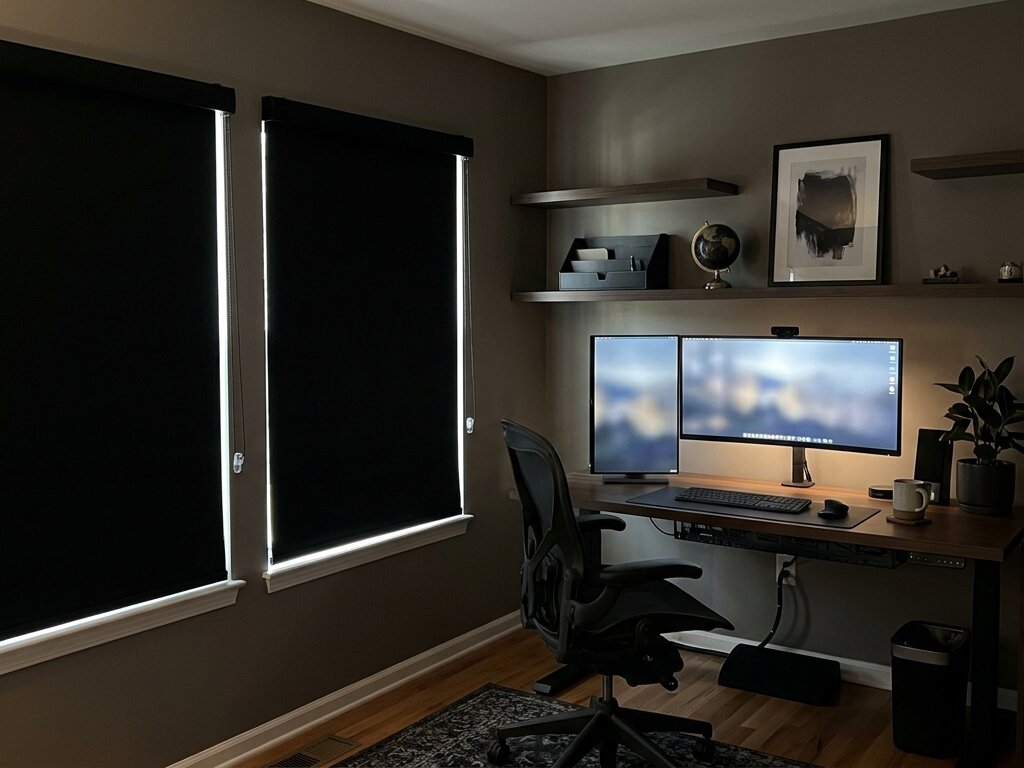
Some home offices need more than glare control. If you do video editing, photography, color work, or anything where you’re controlling the light precisely, or if your office doubles as a media room or a guest room, a roller shade in a room-darkening or blackout fabric gives you that flexibility.
Roller shades share the solar shade’s clean, minimal profile but trade the see-through weave for a solid fabric that blocks far more light. Pair a blackout roller with a solar shade on the same window, a dual-shade configuration, and you get the best of both: the solar shade for everyday glare control with a view, the blackout pulled down when you need the room genuinely dark. It’s an elegant solution for an office that has to do double duty.
For most offices, a light-filtering or room-darkening roller is plenty. A true blackout is worth it only if the work or the room’s second use demands it.
Cellular Shades: For Converted Attics, Garages, and Spare Rooms
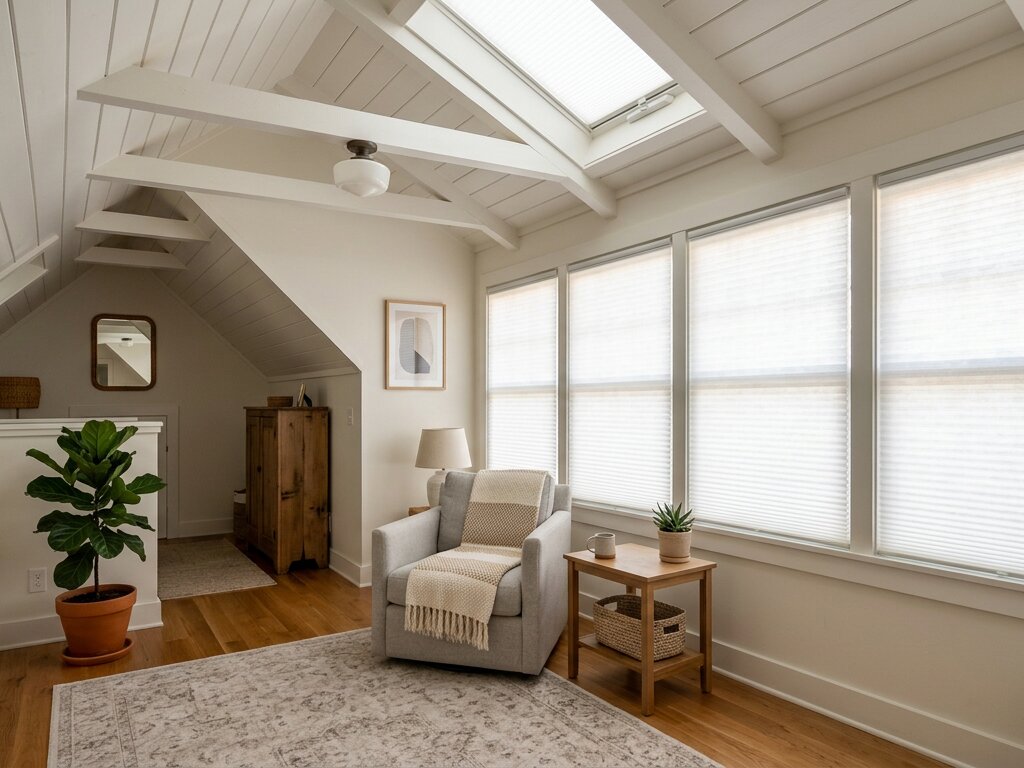
A great many home offices are converted spaces, a finished attic, a room over the garage, a former spare bedroom on the cold north side of the house. These rooms often have a temperature problem the rest of the house doesn’t: they run hot in summer, cold in winter, and the existing windows aren’t always up to the job.
Cellular shades are the answer here. Their honeycomb structure traps an insulating air pocket at the window, measurably reducing heat transfer, so a converted attic office stays cooler in July and a north-facing bonus room holds its warmth in January. For a room you’re spending forty hours a week in, that comfort difference is not minor.
Cellular shades also come in light-filtering and room-darkening fabrics, and with top-down/bottom-up operation if the office faces the street and you want privacy at desk level while keeping light up high. They’re a quietly practical choice for the rooms that became offices by necessity rather than design.
Drapery: Warmth, Quiet, and a Better Background
Here’s the thing most people miss about a home office: it’s the room you appear in. Every video call puts your room on display, and a space with nothing but a functional shade on a bare window reads cold and unfinished on camera.
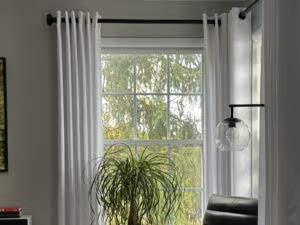
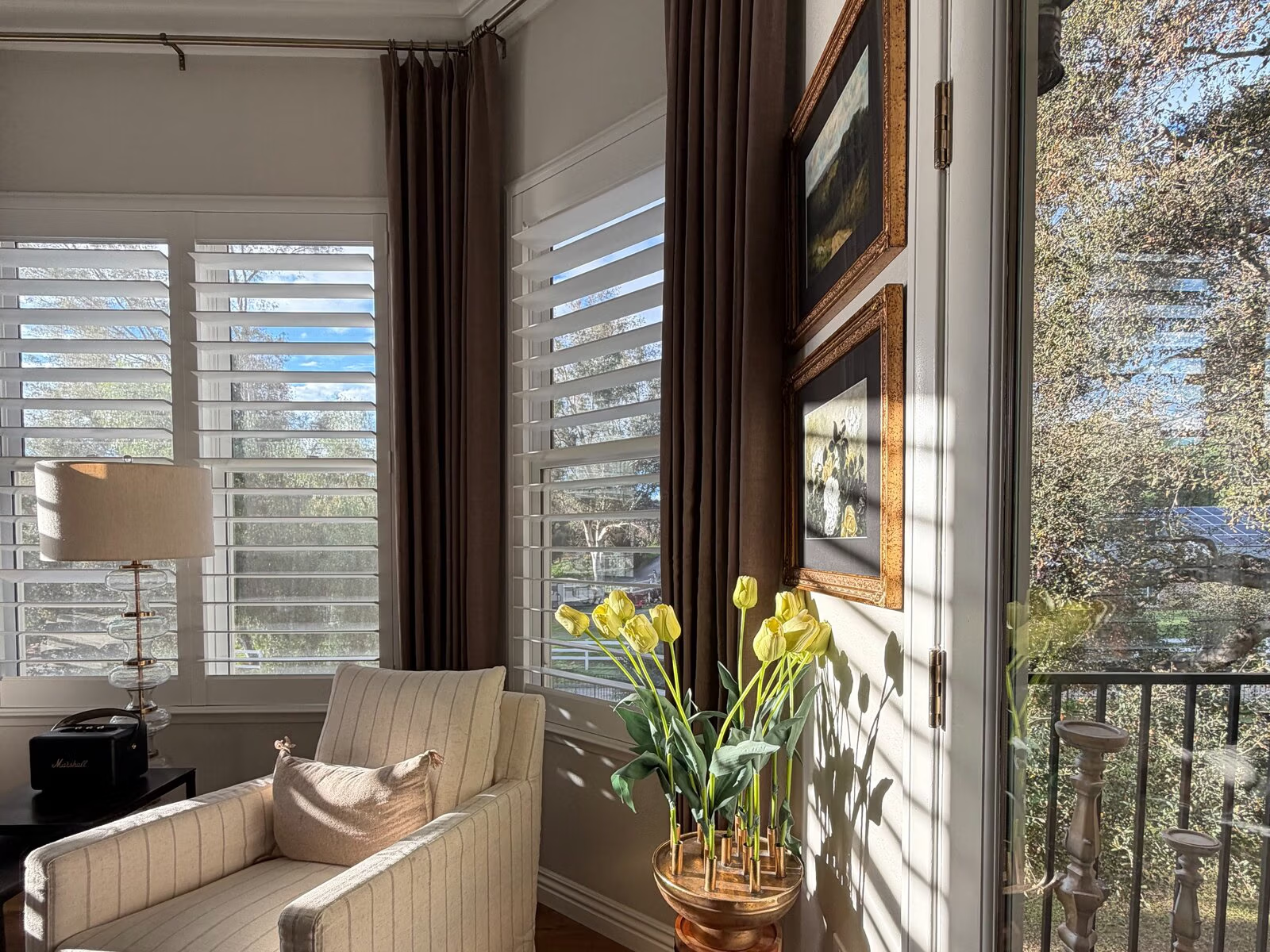
Drapery solves two problems at once. Aesthetically, full-length panels give the room warmth, softness, and a sense of deliberate design, which is exactly what you want behind you on a call. Acoustically, and this is the underrated part, heavy fabric dampens sound. A home office with hard floors, a desk, and bare windows echoes; that echo is audible to everyone on your calls. Drapery, especially in a heavier linen or velvet, softens the room’s sound and makes you come across more clearly.
The home office is the one work environment you fully control, and it’s also the one your colleagues see most often. Drapery is what makes it read as a considered room rather than a repurposed one, and it quietly improves how you sound while doing it.
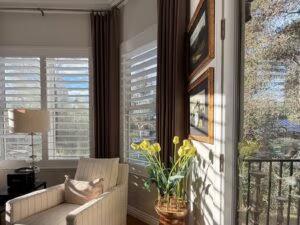
In most offices, we specify drapery layered over a solar shade: the shade handles the daytime glare, the drapery handles the warmth, the acoustics, and the on-camera impression. It’s the same reliable formula that works in a living room, applied to the room where it happens to also make you look more professional.
Motorization: The Upgrade the Home Office Was Made For
If there’s any room in the house where motorization earns its keep, it’s the home office because the whole problem is that light changes through the day, and you’re right there to be interrupted by it.
A motorized solar shade that lowers automatically at the hour the sun starts hitting your screen means you never break focus to fight the glare. A schedule that raises the shades in the morning for light and drops them in the afternoon for the western sun runs the room for you. And for a video call, lowering a shade with an app or a voice command without standing up and walking to the window mid-meeting is the kind of small friction-remover you stop noticing only because it just works.
Battery-powered motors mean no wiring and a clean install even in a finished room, and integration with Alexa, Google Home, Apple HomeKit, or a Lutron system lets the shades become part of a “work” scene alongside your lights. For a room defined by changing light and frequent interruptions, scheduled and remote-controlled shades aren’t a luxury so much as the correct tool for the job.
Color, Texture, and the Camera Behind You
Because the home office appears on camera, its treatments should be chosen partly for how they read on screen. The rule is the same as elsewhere, calm, neutral, supportive of the room rather than competing with it, but the camera raises the stakes.
Avoid anything busy or high-contrast directly behind your usual seat; a loud pattern is distracting on video and pulls focus from your face. Warm neutrals, oat, soft grey, taupe, warm white, photograph well, read professional, and don’t date. Texture helps here too: a slubby linen drapery or a woven shade adds visual interest on camera without the distraction of a pattern, and brings the acoustic benefit along with it.
A practical note on the window behind you: if your desk faces into the room with a window at your back, that backlight is what turns you into a silhouette on calls. A solar or room-darkening shade on that window, lowered during meetings, fixes it instantly, as you control the light coming from behind, so the camera can expose your face properly. It’s one of the most common home-office problems we’re asked to solve, and one of the easiest.
How to Decide
If we had to compress everything above into a short decision tree, it would look like this:
- South- or west-facing office with screen glare: solar shades, 5% openness (3% for severe western glare), to cut the harshness while keeping light and view.
- Office that doubles as a media room, guest room, or editing suite: a dual-shade setup — solar shade plus a blackout roller — for full light control on demand.
- Converted attic, garage, or cold spare room: cellular shades for the insulation, in a light-filtering or room-darkening fabric.
- A window directly behind your desk (the silhouette problem): a solar or room-darkening shade you can lower for calls.
- Any office you appear in on camera: add drapery over the shade — for warmth, for acoustics, and for a background that reads designed rather than makeshift.
And in nearly every home office: motorize it. The light changes all day, you’re right there to be interrupted, and a schedule that runs the room for you is the difference between fighting your windows and forgetting they’re a problem at all.
The Room Where You Do Your Best Work
The home office is permanent now, and it deserves to be treated like a real room rather than a corner that happened to get a desk. The windows are where that shows most: glare that breaks your focus, backlight that undermines your calls, a converted room that’s too hot or too cold to think in. These are solvable problems, and solving them changes how the room feels to work in every day.
Custom window treatments exist for exactly this. Your office has a specific exposure, a specific glare pattern, a specific camera angle, and a specific role in your working life, and the treatments should be specified for all of it, not inherited from whatever the room used to be.
If you’re setting up or rethinking a home office and want help getting the windows right, that’s what we’re here for. Every Ventus consultation starts in the room, in the light you actually work in, at the times of day it actually matters, and ends with treatments measured, made, and installed to make the room work as hard as you do.