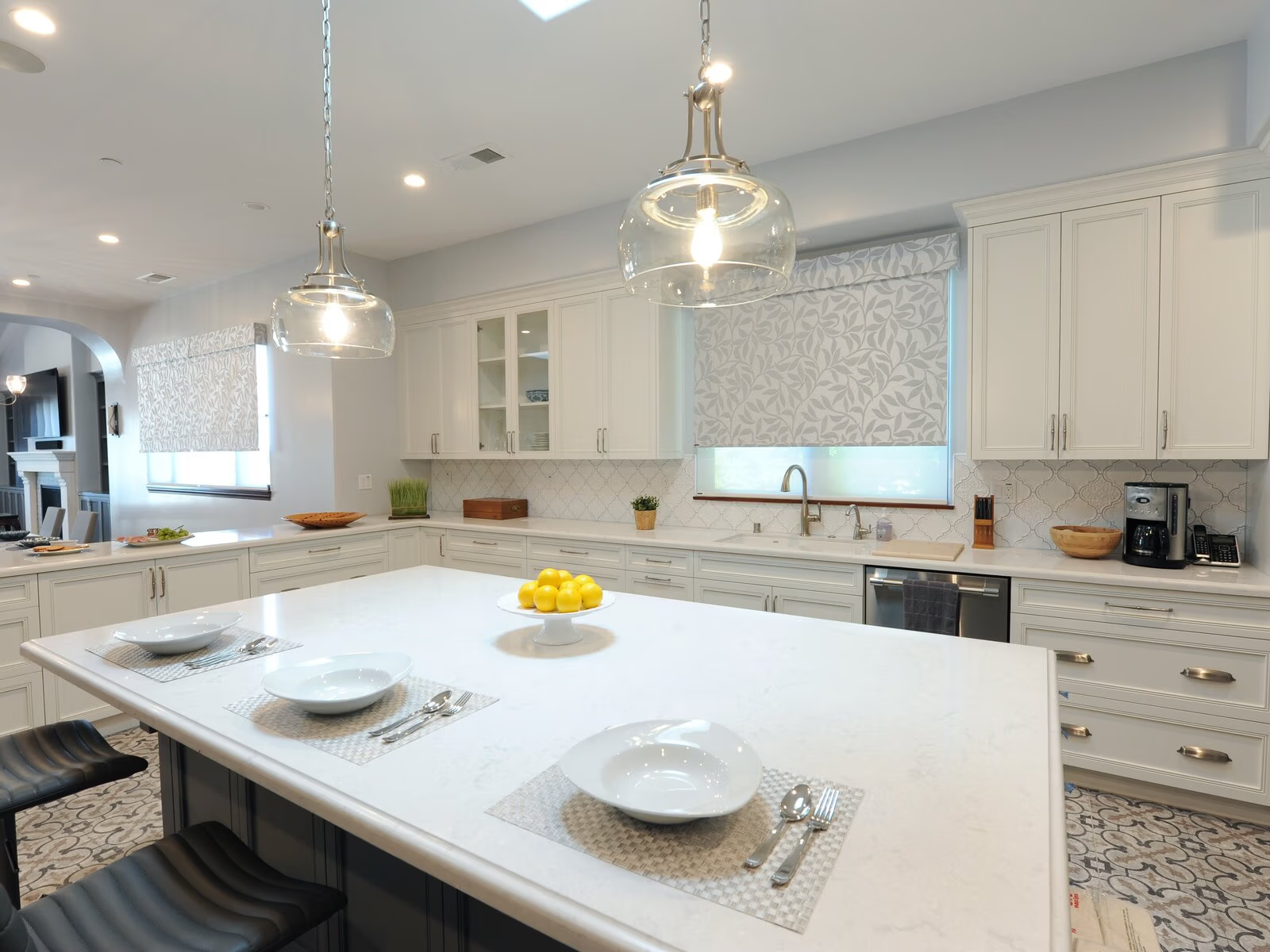
Kitchens and bathrooms are the hardest-working rooms in the house, and they ask something of their windows that no other room does. There’s steam, splashing, and humidity, and some surfaces need wiping down. There are windows directly over sinks, behind faucets, above tubs; places where fabric struggles and where the wrong material warps, stains, or grows tired within a year.
These rooms also have a privacy problem that living rooms and bedrooms usually don’t have. A bathroom window often faces a neighbor at close range. A kitchen window over the sink faces the backyard, the patio, and the street. You want light and privacy at the same time, and you want it from a window treatment that can withstand a humid, splash-prone environment.
The good news: there are treatments built precisely for this. After years of specifying window treatments for kitchens and bathrooms across the tri-state, here is how we think about getting these rooms right.
Start with the Real Constraint: Moisture and Cleanability
In most rooms, you begin with aesthetics. In kitchens and bathrooms, you begin with the environment. How much moisture does this window actually see, and how easily can the treatment be cleaned?
A powder room with no shower has very different requirements than a primary bath with a steam shower. A kitchen window across the room from the range is a different problem than one mounted directly behind the sink and faucet. Get honest about the conditions first, because they rule out certain materials entirely, and that’s a good thing. It narrows the field fast.
The treatments that consistently earn their place in these rooms are faux wood blinds, composite shutters, solar and roller shades, and cellular shades. Each solves a different version of the wet-room problem.
Faux Wood Blinds: The Kitchen and Bathroom Workhorse
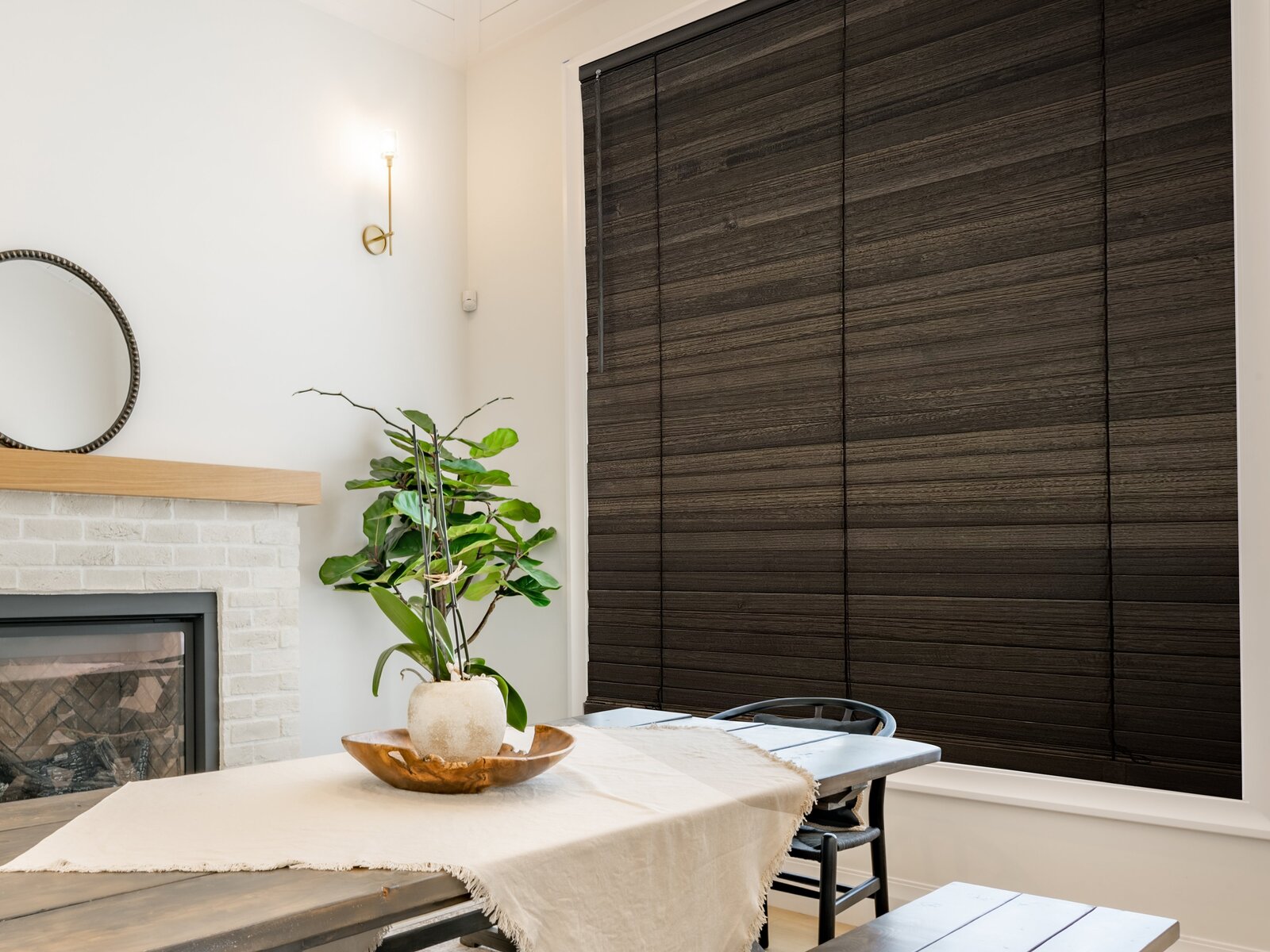
If there’s one treatment we specify more than any other for kitchens and bathrooms, it’s faux wood blinds. They’re made from PVC or composite materials that won’t warp, crack, swell, or fade in humidity, which is exactly what real wood does over time in these rooms.
Modern faux wood is nearly indistinguishable from real wood at a glance, but it behaves completely differently when steam and splashing are involved. You can wipe it down. You can mount it directly behind a sink. It tolerates the daily reality of a working kitchen or a busy family bathroom without complaint.
The single most common mistake we correct in kitchens is real wood blinds installed over a sink. They look beautiful for a season, then the slats nearest the faucet begin to bow and discolor. Faux wood in the same finish solves it permanently, and most people genuinely cannot tell the difference.
Faux wood also gives you that precise, incremental light control blinds are known for, tilting the slats to bounce light up off the ceiling while keeping sightlines blocked from outside, a genuinely useful trick for a kitchen window over the sink or a bathroom that faces a neighbor.

Composite Shutters: The Permanent, Moisture-Proof Choice
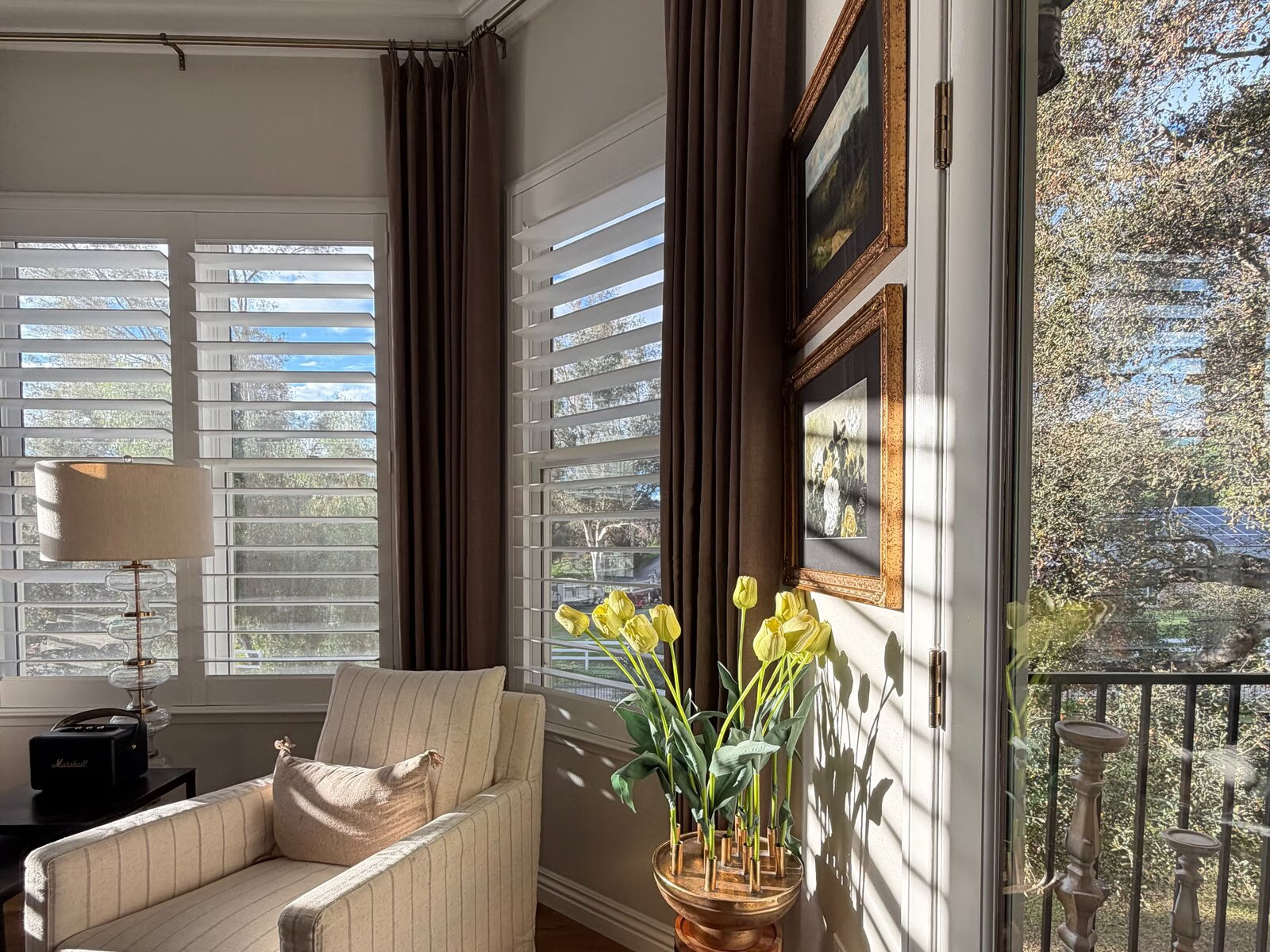
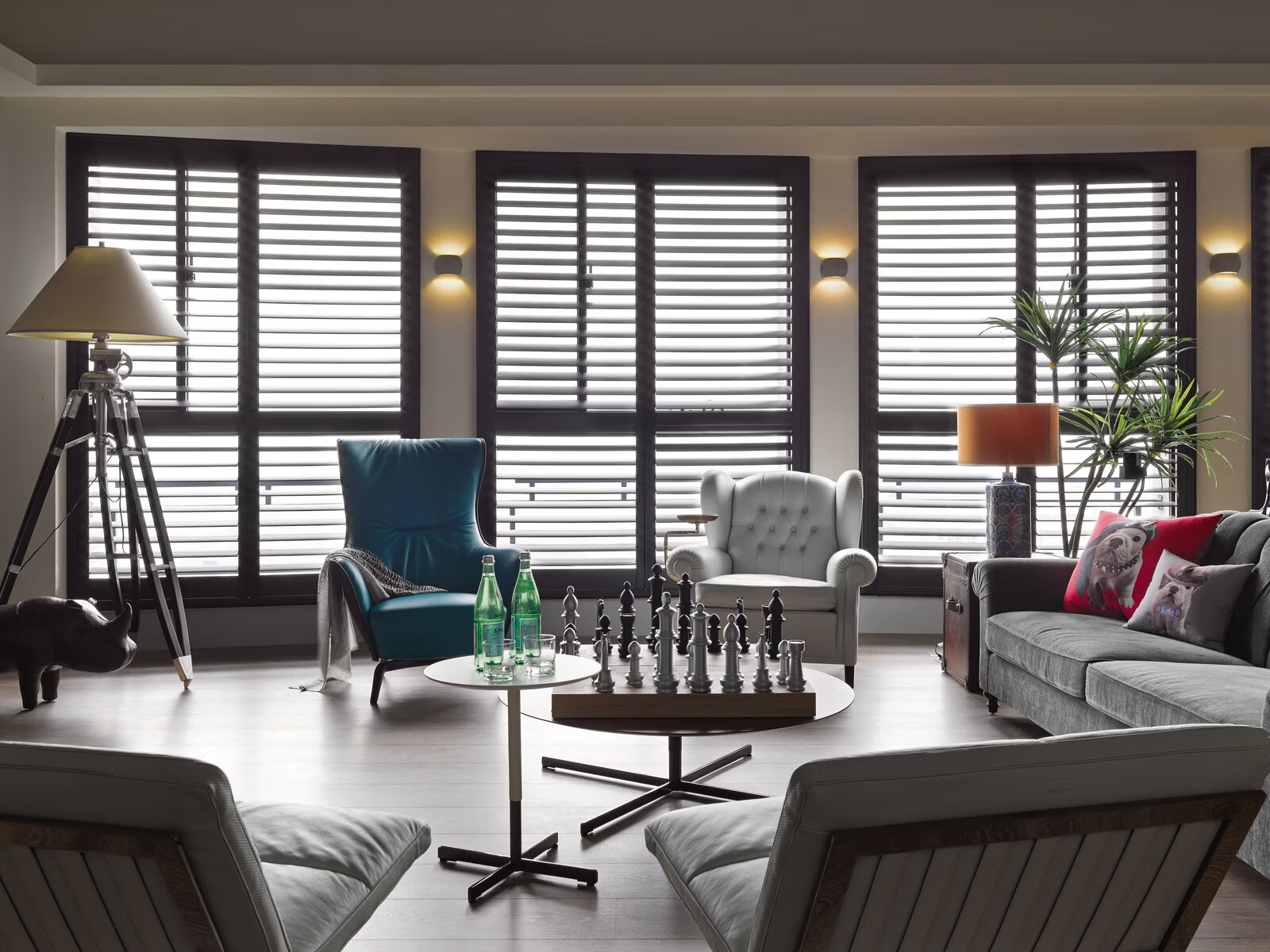
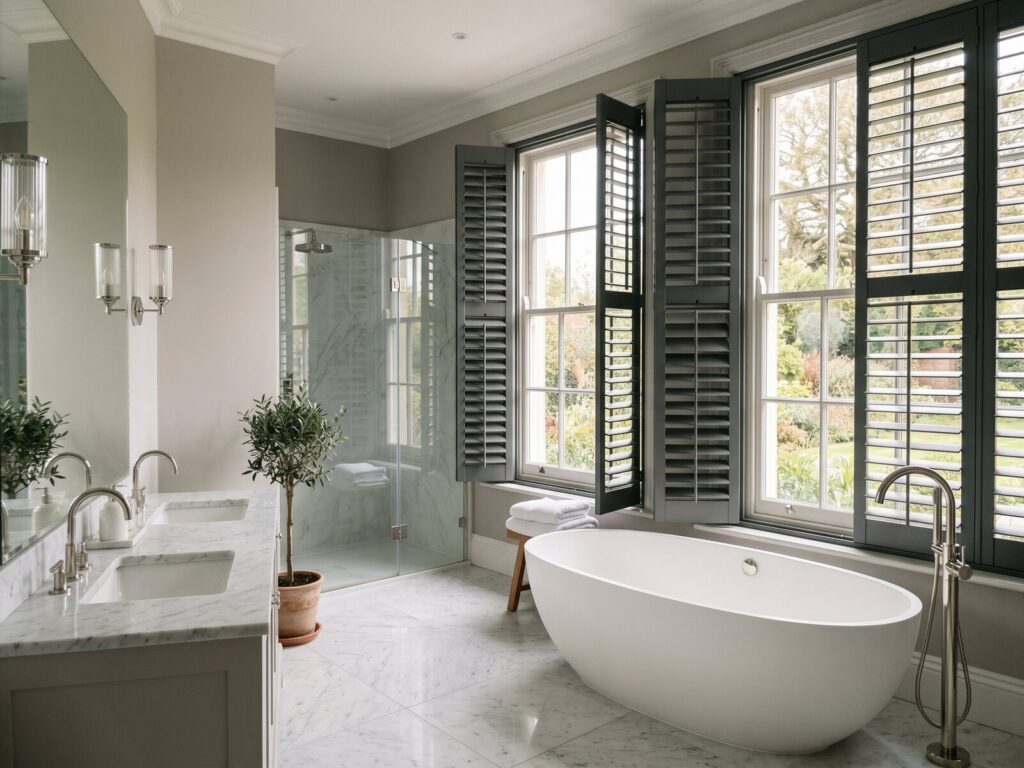
When you want something more architectural and permanent than blinds, composite shutters are the premium answer for wet rooms. Engineered from moisture-resistant materials, they won’t warp or expand the way real wood can, which makes them ideal for bathrooms and kitchens specifically.
Shutters bring something blinds can’t: they read as built-in architecture rather than as an applied treatment. In a bathroom, a set of composite plantation shutters delivers excellent privacy, louvers angled upward let light in while completely blocking the sightline from outside, and they hold up to humidity for decades. They’re also one of the few treatments classified as a permanent home improvement, which means they tend to add resale value, a meaningful consideration in higher-end homes.
The trade-off is cost and commitment: shutters are a larger upfront investment than blinds, and they’re permanent. But for a primary bathroom or a kitchen you intend to keep, they’re often the better long-term value.
Solar and Roller Shades: For Glare, Views, and the Window Over the Sink
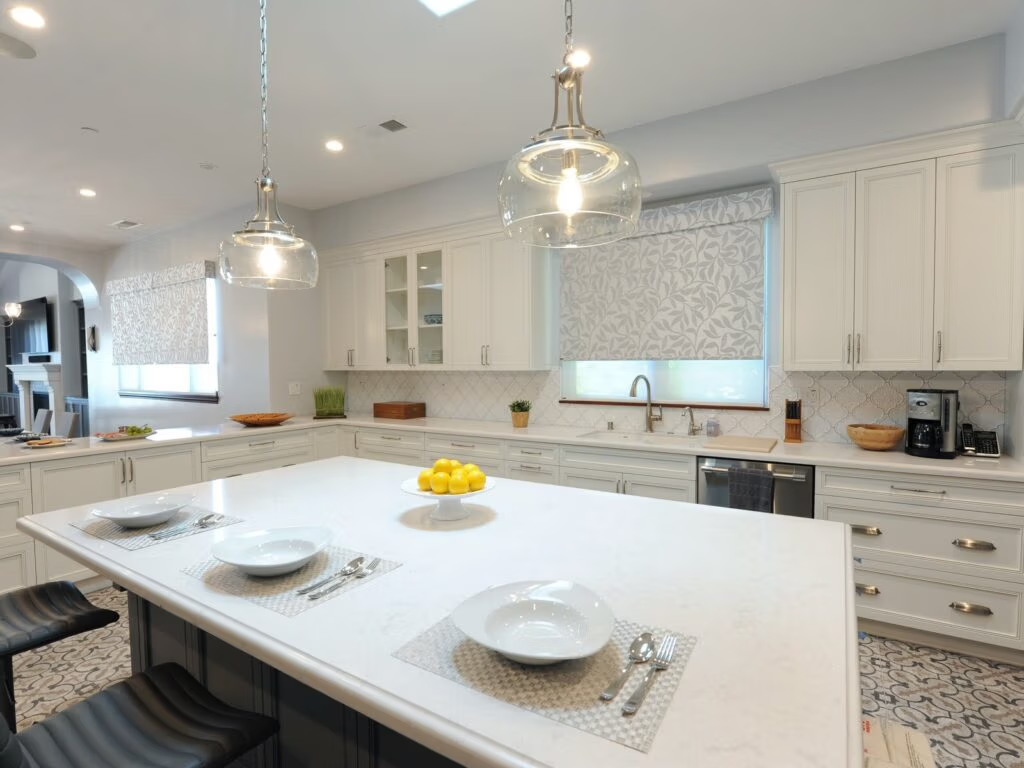
Kitchens frequently have a glare problem. Morning or afternoon sun streaming across countertops and screens is genuinely unpleasant to work in, and it fades cabinetry and finishes over time.
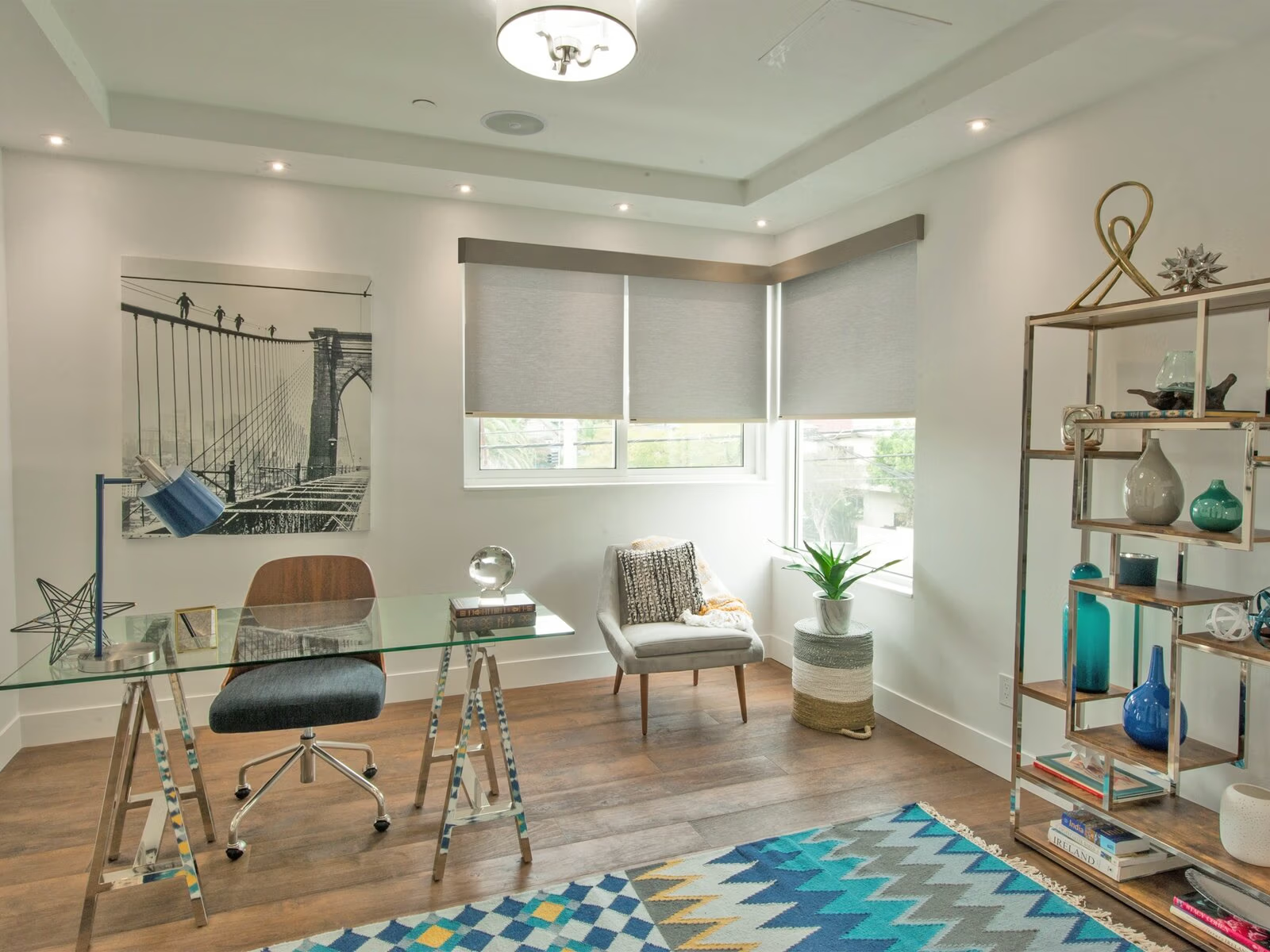
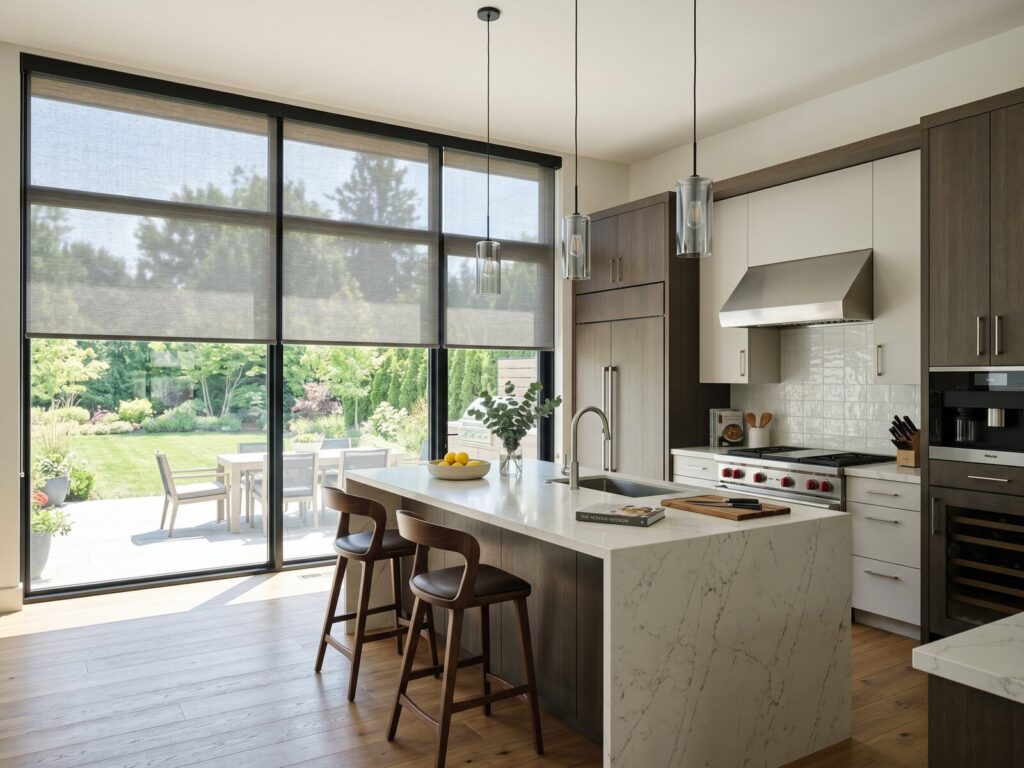
Solar shades are the answer here. Their screen-weave fabric cuts glare and blocks UV while preserving the view out, so you keep your sightline to the backyard while taming the harsh light. For a kitchen window over the sink, a solar shade with the right openness factor gives you daytime privacy from outside while you keep an eye on the kids in the yard.
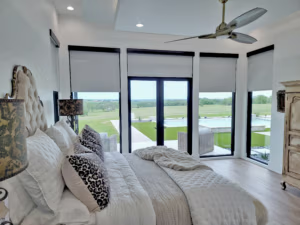
Roller shades in a wipeable, moisture-tolerant fabric are the close cousin: cleaner privacy, softer light, and a simple flat profile that suits modern kitchens beautifully. Both roller and solar shades are easy to operate and easy to keep clean, and both motorize well for windows you can’t comfortably reach behind a sink or counter.
Cellular Shades With Top-Down/Bottom-Up: The Bathroom Privacy Solution
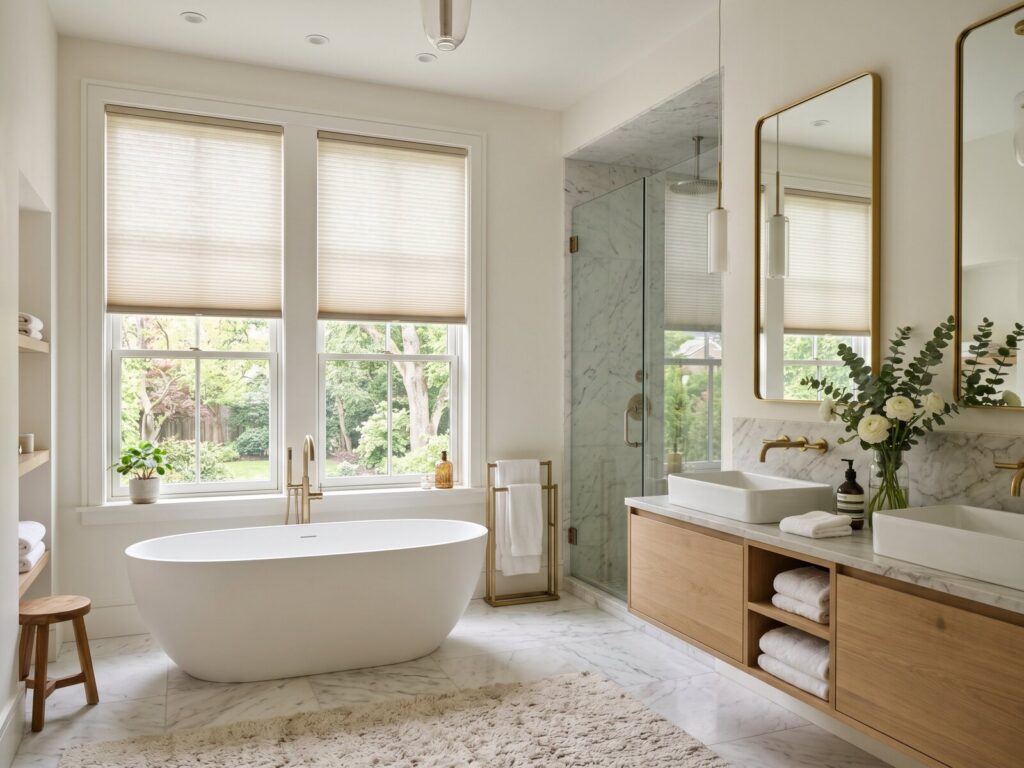
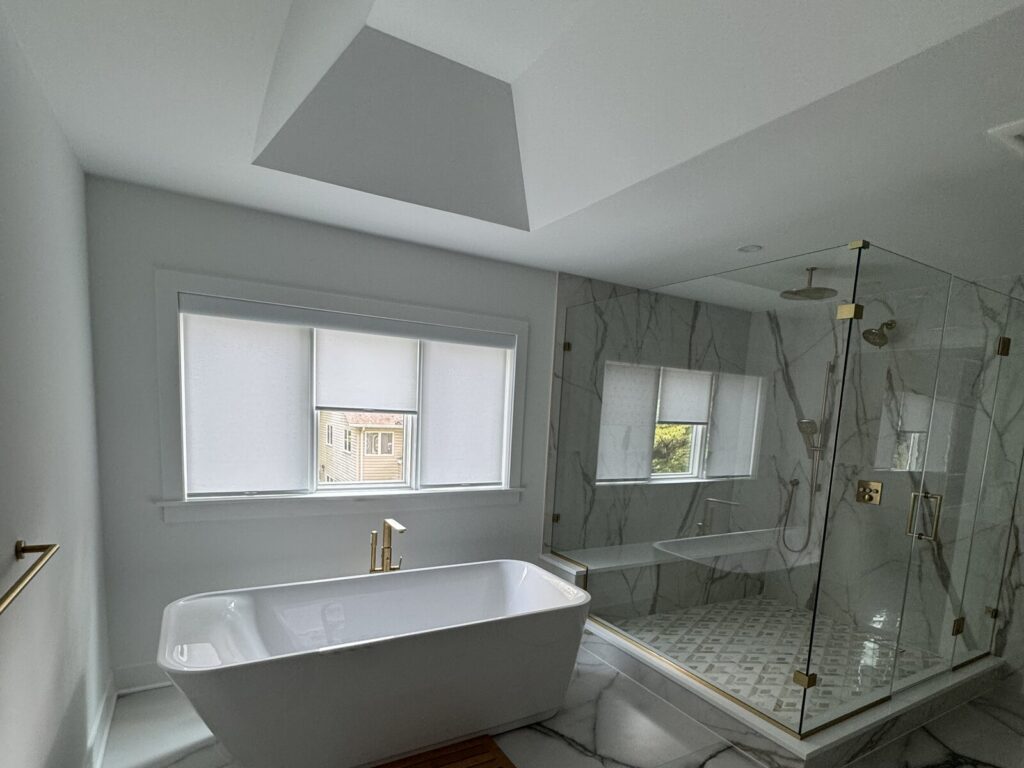
Bathrooms have a uniquely tricky requirement: you want natural light and total privacy, often at the same moment. The treatment that solves this better than any other is a cellular shade with top-down/bottom-up operation.
Top-down/bottom-up lets you lower the shade from the top while keeping the bottom raised, so light pours in through the upper half of the window while the lower half stays completely private. For a bathroom that faces a neighbor, this is close to perfect: daylight at eye level and above, full privacy where you need it.
Cellular shades also bring an insulating air pocket to the window, which is a quiet bonus in a bathroom; they help hold warmth in a room where you’re often standing wet and cold. Specified with a moisture-appropriate fabric and cordless operation, they’re one of the most practical bathroom treatments available.
A Note on Fabric Treatments and Real Wood in Wet Rooms
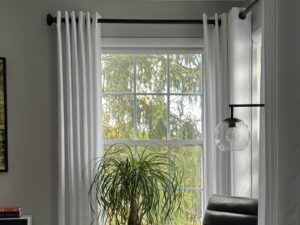
Roman shades, drapery, woven woods, and real wood blinds all have a place in the home, but that place is usually not directly in a steam-and-splash zone.
This isn’t an absolute rule. A large kitchen with a window far from the range and sink can absolutely carry a roman shade or a drapery panel for warmth and softness, and a half-bath with no shower has essentially no moisture constraint at all. The point is to match the material to the actual conditions of the specific window, not to the room’s label. A window across a big kitchen is a different animal from a window over the faucet, even though they’re in the same room.
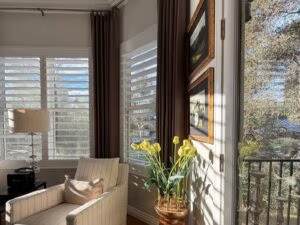
Where you do want fabric softness in a kitchen, a breakfast nook, a window seat, a window well away from water, we’ll happily specify it. We just steer fabric and real wood away from the windows that will punish them.
Motorization: Worth It Over Sinks, Tubs, and Hard-to-Reach Windows
Kitchens and bathrooms are full of windows you can’t easily reach. A window behind a deep farmhouse sink. A window above a soaking tub. A window over a run of countertop and appliances. Reaching across any of these to adjust a shade every day is exactly the kind of small daily friction that motorization erases.
A motorized shade or blind over the sink that raises and lowers with a remote, an app, or a scheduled scene is one of those upgrades people don’t realize they wanted until they have it. Battery-powered options mean no electrician and no wiring, which keeps installation clean even in a finished room. And keeping your hands off a treatment near a sink or tub means it stays cleaner, longer.
Color, Texture, and Keeping It Easy
Kitchens and bathrooms reward restraint. These are rooms with a lot already going on visually, cabinetry, tile, hardware, countertops, fixtures, and the window treatment should calm the room, not add to the noise.
For most kitchens and baths, we recommend clean, light, easy-to-clean finishes: a crisp faux wood in white or a soft warm white, a solar shade in a neutral charcoal or linen tone, a composite shutter in a paint finish that echoes the trim. The treatment should feel like part of the room’s architecture, not a decorative flourish competing with the backsplash.
Cleanability is part of the aesthetic decision here in a way it isn’t elsewhere. A treatment that looks beautiful but is a nightmare to wipe down will look considerably less beautiful after six months of kitchen life. Smooth, wipeable surfaces — faux wood, composite, vinyl-and-screen shade fabrics — stay looking new with almost no effort.
A Word on Safety
Kitchens and bathrooms are often the rooms where children are bathed, fed, and underfoot. Cordless and motorized operation isn’t just cleaner-looking; here, it’s safer. We specify cordless lift systems by default for any home with children or pets, and all our partner manufacturers offer them across blinds and shades. It’s the right call near a tub, a counter, or anywhere small hands reach.
How to Decide
If we had to compress everything above into a short decision tree, it would look like this:
Kitchen window over the sink: Faux wood blinds for tilt control and easy cleaning, or a solar/roller shade if you want a flatter modern profile and glare control.
Kitchen with a glare or fading problem: Solar shades, in an openness factor tuned to the exposure.
Bathroom that faces a neighbor: Cellular shades with top-down/bottom-up operation, for light up high and privacy down low.
Primary bath or a kitchen you’re keeping long-term: Composite plantation shutters moisture-proof, architectural, and value-adding.
A window well away from water (breakfast nook, window seat, powder room): Fabric is back on the table roman shades or drapery for warmth.
And in every wet-room window: choose the material for the conditions first, then make it beautiful. The order matters. A gorgeous treatment in the wrong material is a treatment you’ll be replacing.
Built for the Rooms That Work Hardest
Kitchens and bathrooms are where the gap between off-the-shelf and custom shows up fastest. Standard-size blinds rarely fit these often-odd window dimensions, the wrong material fails quickly in the humidity, and a treatment that ignores the privacy puzzle leaves you choosing between darkness and exposure.
Custom window treatments exist for exactly this. The window over your sink is a specific size, with a specific exposure and a specific privacy situation, and it deserves a treatment specified for those exact conditions in a material built to live there.
If you’re planning new treatments for a kitchen or bathroom and want help thinking through the right combination for your space, that’s what we’re here for. Every Ventus consultation starts in the room, with the light and the conditions you actually live with, and ends with treatments measured, made, and installed to perform beautifully in the rooms that ask the most of them.